How long durian actually keeps
The most important point: an opened durian left at room temperature is good for hours, not days. Singapore’s food agency, the SFA, says to discard cut fruit left at room temperature for more than two hours, and to refrigerate it at 4°C or below.
Whole, unopened fruit lasts longer because the husk protects it.
There is little official guidance on durian storage itself. One published seller guide, from a Malaysian frozen-durian seller, Top Fruits, gives these figures:
- Whole, unopened, in the fridge at 0 to 5°C: 5 to 7 days
- Fresh flesh, chilled: 2 to 4 days
- Leftovers from a fruit you have opened: eat within 2 days
- Fresh flesh wrapped in cling film, sealed in a zip bag and frozen: about 2 months
- Its own frozen durian at around -18°C: up to 18 months, best eaten within 3 months
The guide does not explain why it gives 2 days for leftovers and 2 to 4 days for fresh flesh. The shorter figure is the safer one to follow.
If you have bought more than you can eat tonight, decide today whether it goes in the fridge or the freezer.
This matters more in a glut year. In the 2026 season, Grade A Musang King from one Pahang orchard sold in early July for about half the 2025 price. Cheap fruit tempts people to buy more than they can finish in one sitting.
In the fridge
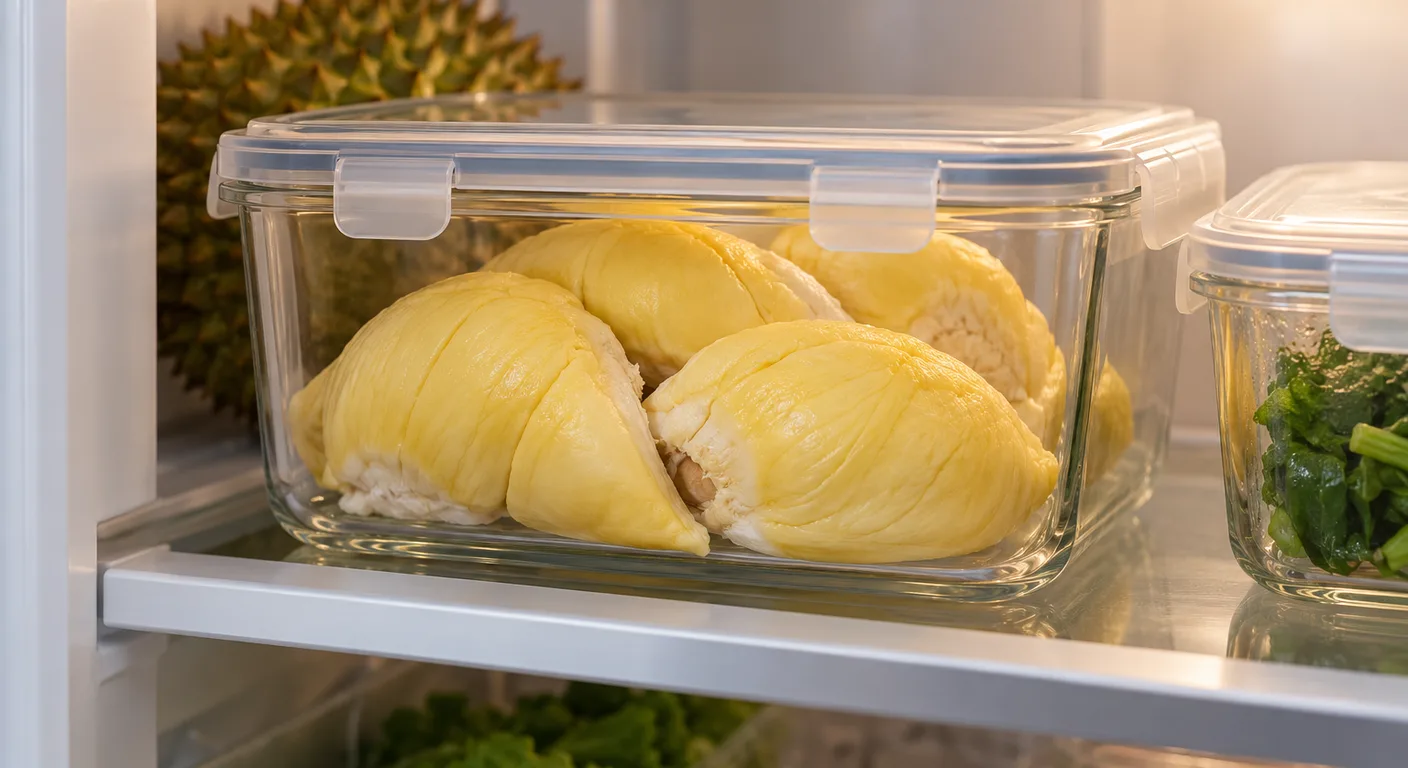
Does durian need to be refrigerated? Once opened, yes. Deshell the fruit, put the flesh in an airtight container, refrigerate it at 4°C or below, as the SFA advises for cut fruit, and eat it within the seller’s 2 days.
If you must keep a whole unopened durian, put it in the fridge contained, never bare on a shelf. Uncontained, the smell spreads to everything in the fridge. Wrap it or bag it, and keep to the 5 to 7 day window.
One thing the fridge does not fix: fruit that was already overripe when you bought it. Chilling slows the change, it does not reverse it. If the flesh was watery at the stall, it will not improve overnight.
Knowing how to choose a durian at the point of sale saves you more than any storage method.
In the freezer
Freezing is the right call for anything you will not eat within two days. Deshell the fruit and freeze the flesh.
Wrap individual pods tightly in cling film or a food-grade bag. Then pack them into a dry airtight container or a heavy duty zip bag.
For fresh flesh you wrap and freeze, the seller figure is about 2 months. Its 18 months applies to its own commercially frozen product, and even then it says to eat it within 3 months.
Peer-reviewed work on freezing durian is thin. A 2023 study in Tropical Life Sciences Research froze whole fruit at -15°C and held it at -10°C. Quality held through the 30 days it tested, and the authors say longer storage needs more research.
Defrosting is where most people go wrong. Thaw it slowly in the fridge for a few hours, and thaw only what you will eat. Plan ahead: move tomorrow’s portion from freezer to fridge tonight.
Avoid quick thawing in a microwave or hot water, and do not refreeze what you have thawed. The seller warns that improper thawing and refreezing can affect the taste.
And a hard rule: if you do not know when something was frozen, discard it. Label the container with the date when it goes in.
Keeping the smell out of everything else
Durian smell travels through a fridge faster than most people expect, and once it is in your butter and your milk it is hard to get out.
The defence is layers. Wrap the flesh in cling film first, then put it into an airtight container: Tupperware, Lock&Lock, vacuum sealed boxes, or heavy duty Ziploc bags all work.
Glass is likely the better choice. A 2007 Technical University of Munich study of milk packaging found polyethylene readily absorbs odour compounds, while glass barely does. Plastic boxes used for durian tend to keep the smell, so keep a dedicated set.
For smell that has already escaped, some people leave pandan leaves, baking soda or a small dish of ground coffee in the fridge.
How to tell it has turned
Do not taste flesh you suspect has turned. Look and smell first.
Signs it has gone: a sour, sharp smell, sometimes with a faint alcohol edge, or watery, slack flesh that has lost its body.
Fresh flesh that looks and smells normal is not proof it is safe, especially if it sat out. If in doubt, throw it out.
Buy fresh, chill it promptly, freeze what you will not finish the same day.
Sealing it properly also decides whether you can move it at all. Packed, sealed flesh travels in situations a whole fruit does not: see where you cannot take durian for the MRT, taxi, hotel and airline positions.
Most durian delivery in Singapore arrives this way, as flesh in a sealed box rather than whole fruit.